
Files
Download Full Text (1.4 MB)
Abstract
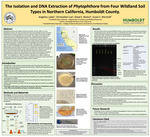
Phytophthora species are of global importance (Sinclair and Lyon, 2005). For most Phytophthora species, the natural mechanism of how these pathogens travel and spread long distances is not fully understood. They are have been shown to travel by air, water, nursery stock, and via inadvertent human transport. The purpose of this study was to identify the presence of Phytophthora species in four different Northern California forest/wildland soil types. Soils from Franciscan complex parent material (riparian, mixed conifer, and oak woodland), and serpentine parent material (mixed conifer) were sampled in Humboldt County (Fig 1). Phytophthora and other pathogens were baited from each soil type with Rhododendron leaf disc (Fichtner et al. 2007, Reed lab) and Port Orford-cedar baits. To select for Phytophthora sp. we cultured baits on clarified VS agar containing PARPNH (Reed Lab) with follow up isolation on a modified layer Ampicillin plate method to eliminate bacterial contamination. Large hyphal quantities were cultured in a clarified VS broth, rinsed, and freeze-dried. DNA was extracted using either a NaOH method (Osmundson et al. 2012) or the Plant DNeasy kit to compare results. DNA was amplified using PCR with ITS (internal transcribed spacer) primer pairs ITS 5-4 (Ristaino et al. 1997), ITS 6-4 (Ristaino et al. 1997), and Phytol-4 (Davidson et al. 2003). Purified PCR products from both extraction methods were submitted for sequencing. Initial results point to Phytophthora species including P. cambivora and P. undulata.
Type/Genre
Poster
Disciplines
Forest Sciences
Timeline
2015
Creative Commons License

This work is licensed under a Creative Commons Attribution-Share Alike 4.0 International License.